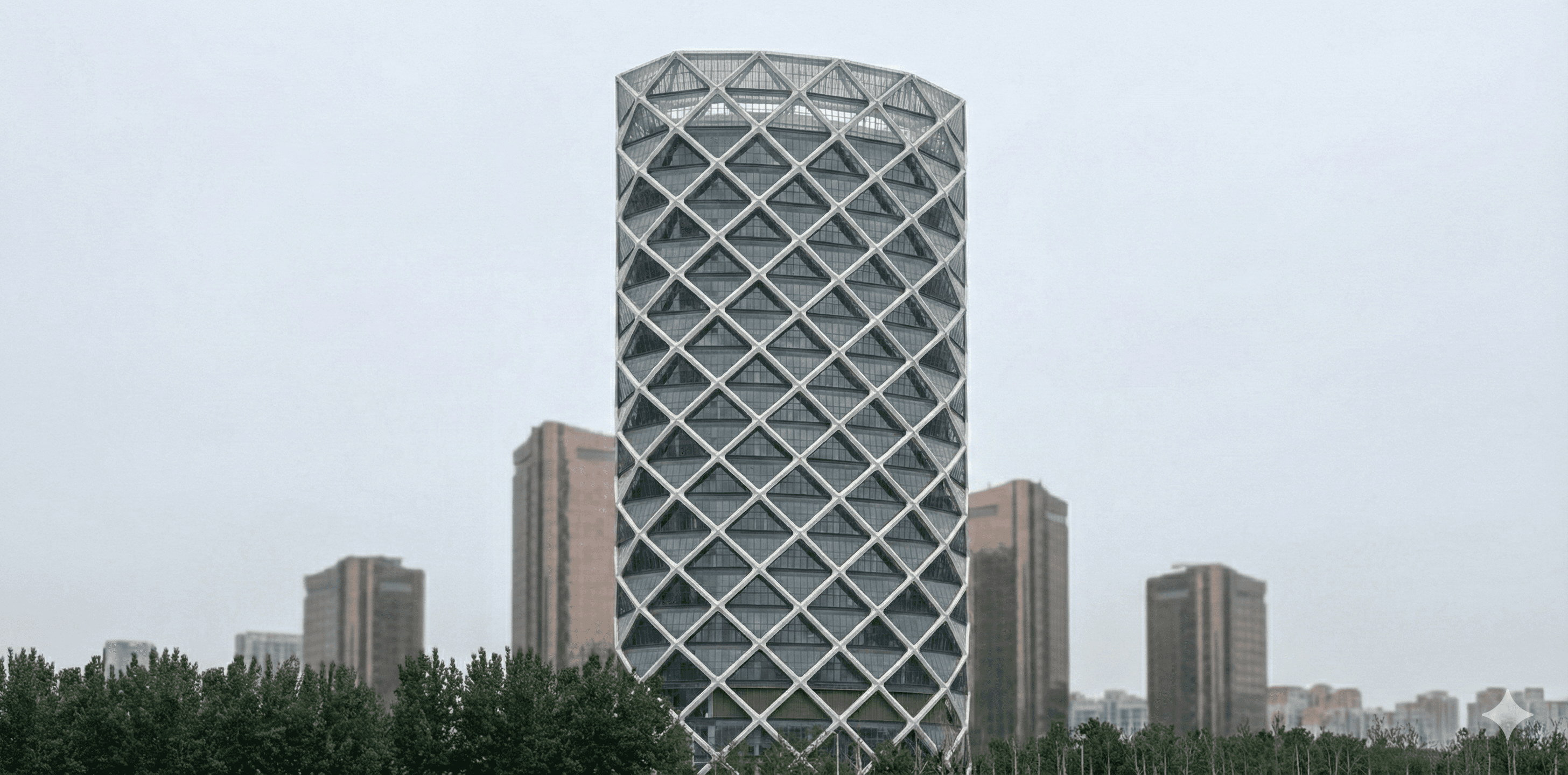
Case Study
Poly International Plaza - Parametric Diagrid Study
A small interactive 3D diagrid demo (orbit + sliders) and an explanation of the Python parametric logic I developed.
- Role
- Parametric Design Technologist
- Status
- Case Study
- Stack
- Python, Parametric Modeling, 3D Visualization
Project Summary
Poly International Plaza required a diagrid facade system that evolved continuously as the tower form was explored. This page documents a simplified interactive study and the core parametric logic I developed to keep the structural system aligned with rapid iteration.
Interactive 3D Study
Poly International Plaza
SOM | Beijing | Parametric Diagrid Explorer
The Problem: A Diagrid That Had to Move With the Building
During design, the diagrid could not be treated as a static pattern. As the building shape was refined, key drivers changed in parallel:
- Tower geometry (overall form exploration)
- Floor-to-floor heights
- Variation between lower floors and mid-level floors
- Diagrid density and alignment across transitions
The challenge was that the floors were not supported by a conventional column grid. The structural intent required the floor system to coordinate precisely with the diagrid, meaning even small geometric changes had downstream impacts.
Why Precision Mattered
This was not a visual parametric exercise. The model needed to remain exact and constructible while design and documentation moved quickly. The diagrid geometry had to stay synchronized with floor edges, node locations, and structural logic so the system could be trusted as the building progressed toward construction.
The Solution: Python-Driven Parametric Modeling in Revit
The only reliable way to keep up with the speed of iteration was to generate and update the diagrid system using Python-based parametric logic. The scripts allowed the facade structure to adapt to changing constraints while maintaining consistent rules for:
- Node spacing and alignment
- Diagrid spacing across height transitions
- Coordination with changing floor-to-floor conditions
- Rapid regeneration as the form evolved
The intent of this page is to show that same idea in a lightweight interactive demo: a structural system that responds immediately to key variables, demonstrating how code can steer a building's design space while preserving constructability.
References
My Role
Parametric Design Technologist